
When my eldest turned a year old, we started looking at preschools. We were so clueless then that we didn’t even know there were different types! In our day, most of us just went to kindergarten at age five, and it would be the one nearest to our homes. There wasn’t talk about curriculums, anchor operators or childcare subsidies.
We naively assumed all preschools are the same. It was only after we started visiting centres (and googling furiously at night) that we realised how many options there were — and how different they could be.
If you’re in the same boat, here’s a quick guide that breaks it all down: the different types of preschools in Singapore, how they’re structured, and what might work best for your family.
When people say “preschool,” they’re usually referring to either a childcare centre or a kindergarten. Both serve children before Primary 1, but the key differences lie in their hours, age range and overall focus.
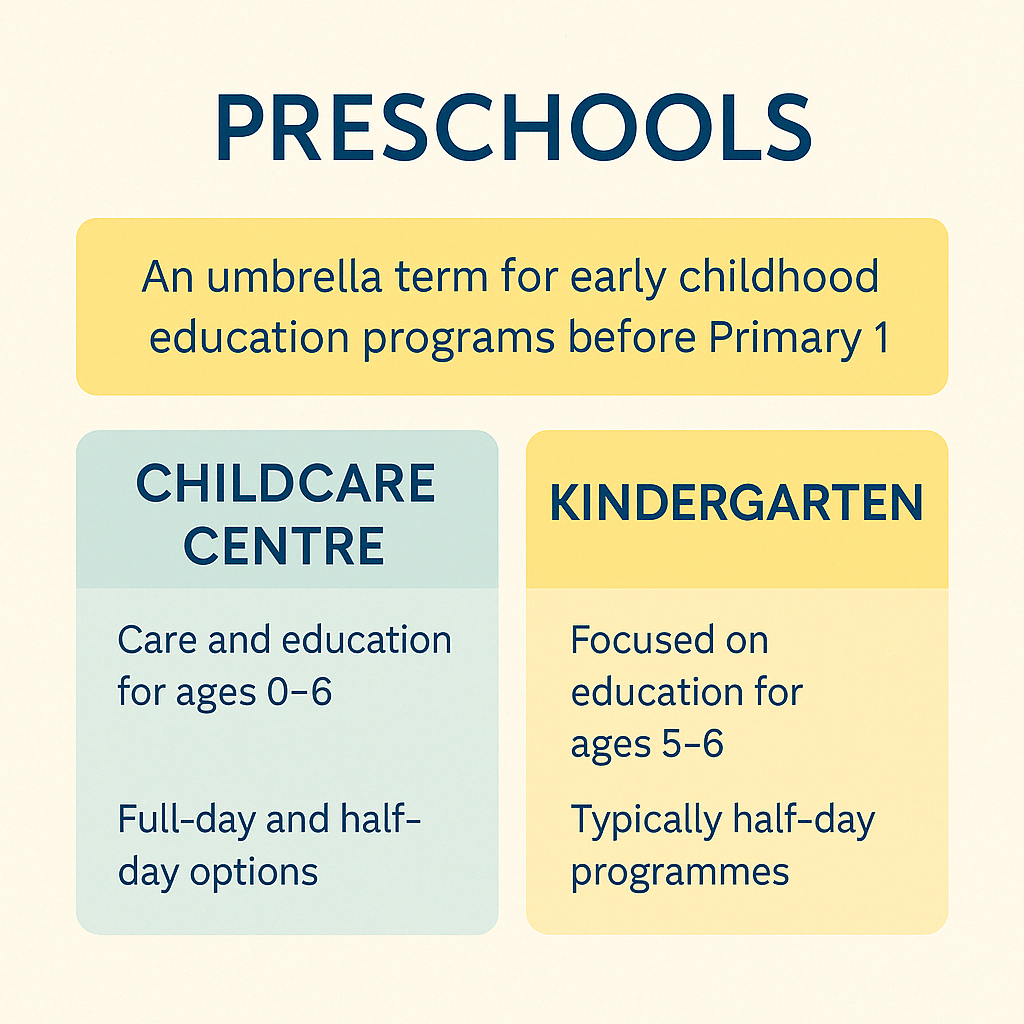
Childcare centres (Ages 0–6)
Childcare centres offer both care and education, starting as early as a few months old. They cater to working parents who need full-day or extended care, and typically run from around 7am to 7pm.
Children progress through different stages within the same centre — from infant care to playgroup, nursery and kindergarten levels. While the days are longer, the learning approach is often play-based and balanced with nap times, meals and routines to support young children’s development.
Best for: Families who need longer hours and want a single place from babyhood to K2.
Kindergartens (Ages 5–6)
Kindergartens are more structured, with a greater focus on preparing children academically and socially for Primary 1. They typically start at age 5 (K1) and run for just a few hours in the morning or afternoon — usually 3 to 4 hours per session.
MOE Kindergartens fall into this category and follow a curriculum developed by the Ministry of Education. Other kindergartens may be run by religious groups, non-profits or private schools.
Best for: Families who don’t need full-day care, and want a focused early education programme before primary school.
Do note that some kindergartens, such as MOE Kindergartens, partner with external vendors to offer additional half-day childcare services — a helpful option for working parents. For example, MOE Kindergartens provide a KCare programme, where children are cared for before or after their regular lessons.
Childcare:
If you’re beginning your preschool search, it helps to understand what kinds of childcare programmes are out there — and how the funding model behind each one affects things like fees, locations and even waitlists.
In Singapore, many childcare centres fall under government-supported schemes that aim to make preschool more affordable, accessible and consistent in quality. The three main groups you’ll come across are:
Anchor operators (AOP)
These are large, government-supported preschool operators appointed by ECDA (Early Childhood Development Agency). They receive substantial funding and in return, must keep fees affordable, meet quality standards, and open centres in newer or less-served estates.
Examples:
PCF Sparkletots, My First Skool, Skool4Kidz, E-Bridge
Worth noting:
Because of fee caps, Anchor Operator centres are among the most affordable preschool options — with full-day childcare fees typically around S$720/month before subsidies. They also tend to have many outlets, especially in HDB estates.
Partner operators (POP)
POP preschools are run by mid-sized operators who also receive government support, though not as much as AOPs. They must cap fees, improve programme quality (like teacher training or curriculum), and meet governance standards — but have a little more flexibility than AOPs.
Examples:
Star Learners, MY World Preschool, Little Footprints, Small Wonder
What to expect?
POP centres tend to charge slightly higher fees than AOPs (around S$800–$900/month), but they also tend to offer diverse learning approaches and centre styles.
Other preschools (private or niche)
These are fully self-funded preschools — often offering niche or premium programmes, such as Montessori, bilingual immersion, or arts-based approaches. Some are also faith-based or cater to children with special needs.
Examples:
MindChamps, Chiltern House, some church kindergartens and special needs schools
Worth noting:
Fees vary a lot, from S$1,500/month to S$3000/month, especially if enrichment programmes and smaller class sizes are included.
How do subsidies work?
If you’re a Singapore Citizen and your child is enrolled in an ECDA-licensed preschool, you’re likely eligible for subsidies that can significantly lower your monthly fees.
There are two main types of subsidies:
Basic subsidy
This applies to all Singaporean children enrolled in full-day or half-day childcare.
- Working mothers (min. 56 hours/month) get:
Up to $300/month off full-day fees - Non-working mothers get:
Up to $150/month
Additional subsidy
If your gross monthly household income is $12,000 or below, you may qualify for even more support. The lower your income, the higher the subsidy, potentially reducing fees to as low as $3/month in some cases.
Subsidies are only applicable at childcare centres — not kindergartens.
Kindergartens:
In Singapore, “kindergarten” typically refers to half-day programmes for children aged 5 to 6 years old (K1 and K2), with some offering Nursery from age 3.
You might find kindergartens as:
- Part of a childcare centre (e.g. AOP or POP centre that also offers K1/K2 levels)
- Stand-alone kindergartens (e.g. MOE Kindergarten or church-run ones)
MOE Kindergartens (MK)
MOE Kindergartens (MK) are kindergartens run directly by the Ministry of Education. They’re designed to offer high-quality, affordable early education and are closely aligned with the national Primary 1 curriculum.
- Operate 4-hour sessions, AM or PM
- Flat monthly fee of $160 for Singapore Citizens (regardless of income)
- Priority admission to the partner primary school
There are currently MOE Kindergartens in many neighbourhoods, and more are being opened gradually.
Other standalone kindergartens
These include kindergartens run by:
- Religious organisations (e.g. Anglican, Methodist, Buddhist temples)
- Community groups or non-profits
- Some private international preschools offering part-day options
They often have their own curriculum focus — such as values-based education, bilingual programmes, or faith teachings — and may cost anywhere from $200–$800/month, depending on the centre.
Kindergartens are not eligible for ECDA childcare subsidies, but some may offer financial assistance through their own organisation.
Step-by-step guide to choose the right preschool
1. Start with your child’s age.
- If your child is 2 months to 4 years old, you should be choosing between the various childcare centres (also called infant care and preschool).
- If your child between 5 to 6 years old, you can consider both childcare centres and kindergartens.
2. Look at the curriculum and teaching approach.
- Are you looking for play-based learning, Montessori, Reggio Emilia, academic-focused or a bilingual programme?
- Think about what suits your child’s temperament and your family’s values.
3. Consider practical preferences.
- Location: Near your home or workplace?
- Daily schedule: Do the programme hours work with your lifestyle?
- Teacher-student ratio and school culture: What feels like a good fit when you visit?
4. Check fees and subsidies.
- Childcare centres and kindergartens differ in cost — be sure to ask about monthly fees, registration costs and uniform/material charges.
- See if you’re eligible for ECDA subsidies, MOE fee structures or additional financial assistance.
5. Visit the centre if possible.
- Book a school tour or attend an open house.
- Observe how the teachers interact with children, ask about routines and trust your instincts.
6. Apply early.
- Spaces can be limited, especially in popular centres.
- MOE Kindergartens and many others have specific registration periods, so mark your calendar.



 This Little Season